
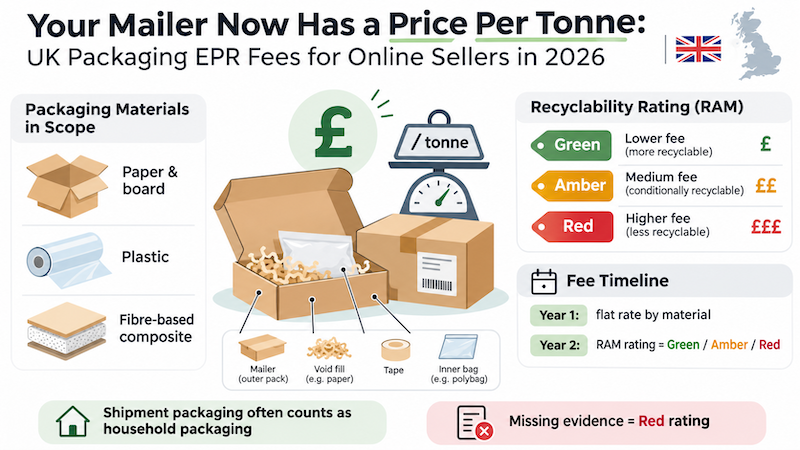
The first year of UK packaging EPR charged one flat rate per material. The second adds a recyclability rating, and any packaging a seller cannot evidence is rated red.
In the first year of the UK's packaging extended producer responsibility scheme, PackUK charged large producers £196 a tonne for paper and card, £423 for plastic and £461 for fibre-based composite, which is paper bonded to a plastic layer. For an online seller, those three lines cover nearly everything in a parcel. The second year changes how the bill is worked out, and PackUK has said the notices of liability for it will be issued later this calendar year.
Who pays, and who only reports
The scheme reaches UK businesses with a turnover of £1 million or more that supply or import more than 25 tonnes of packaging a year. Within that group, only large producers, with more than £2 million turnover and more than 50 tonnes, pay the waste disposal fee. Small producers register, report once a year and keep records for seven years, but do not pay it.
For a retailer selling online, the parcel is often the largest part of that tonnage. Government guidance treats shipment packaging, the box or mailer that carries an order to a consumer, as household packaging unless the seller can evidence otherwise, and the fee is charged on household packaging. If a fulfilment house packs orders in your branded packaging, the obligation stays with you. Marketplace operators carry their own obligation for packaging that non-UK sellers supply through them.
The next date to diarise is 1st April 2027. Large producers report their July to December 2026 data by then, and small producers report the whole of 2026.
From flat rates to red, amber and green
Year one charged every tonne of a material the same. From the 2026 to 2027 year, fees are modulated by the Recyclability Assessment Methodology, or RAM, which rates each packaging item red, amber or green. Amber pays the base fee. Red pays more, at 1.2 times the amber rate in 2026 to 2027, 1.6 times in 2027 to 2028 and twice the amber rate in 2028 to 2029, according to PackUK's modulation statement. Green receives a discount funded by the red surcharge.
PackUK has not yet published confirmed fees for 2026 to 2027. Its illustrative rates, last updated in December 2025, look like this for the three materials an online seller uses most:

Amber, the rating that carries no modulation, is still higher than last year's flat rate for every material in the table. And red-rated composite is illustrated at more than three times the rate for green paper and board.
There is also a lag. The 2026 to 2027 fees are calculated on packaging supplied in 2025. Anything a seller changes this winter shows up in its 2026 data, and so in the following year's bill, when the red multiplier rises to 1.6.
The red rating you get for missing paperwork
If a producer cannot provide evidence for a household packaging item or component, it is an automatic red. A mailer can be perfectly recyclable in practice and still be charged as if it were not, because nobody can show what it is made of.
"A red rating can be a paperwork result rather than a design result," says Simmy Lin, General Manager of Bk-bags, a Ho Chi Minh City based supplier of reusable shopping bags and e-commerce packaging. "A seller asks for a recyclability rating, the supplier sends a product name and a photograph, and the item goes in as red. Before the next reorder, ask the supplier to answer the RAM questions for that item in writing."
Large producers assess 2026 packaging under RAM version 1.1. A revised version, RAM 2027, applies to packaging reported for the 2027 year.
Mailers, void fill and the 5 per cent line
Reporting runs component by component: the weight and material of each component is reported separately. In a typical parcel, the mailer or box, any inner bag, the void fill and the tape are each a line in the return.
For mailers, the material category does most of the work. Paper or board with one or more plastic layers that cannot be separated by hand counts as fibre-based composite once the plastic is more than 5 per cent of the mass. At 5 per cent or less it is reported as paper or card. A kraft mailer with bonded bubble film is well over the line. A paper mailer with a thin plastic coating may sit close to it, so the plastic and the fibre weights belong on the specification as two figures rather than one gross weight.
Take 100,000 mailers at 25 grams each, which is 2.5 tonnes. At the illustrative year two rates, that is about £1,575 if they are rated red as composite and about £475 if they are rated green as paper and board. Same parcel count, different specification.
Void fill follows the same arithmetic. Paper fill sits in the paper and board band, while air pillows and bubble film are plastic. The weight counts whatever the material, so a box that needs less fill costs less to report. For buyers comparing formats, this material-by-material breakdown of mailers, inner bags and void fill lists the common options and what each is made of.
Plastic carries a second, separate charge. HMRC's Plastic Packaging Tax is £228.82 a tonne from 1st April 2026 on plastic packaging components with less than 30 per cent recycled plastic, for businesses that make or import 10 tonnes or more. It is paid on top of the EPR fee, not instead of it.
Five ways to cut the bill
- Confirm which side of the thresholds you sit on. Turnover and tonnage decide whether you pay the fee at all. A seller near 50 tonnes should know which components take it over.
- Weigh, do not estimate. Fees are charged per tonne by material. Weigh a sample of every component, including tape, labels and inner bags.
- Get evidence of every item. Ask suppliers for the material of each layer, the weight of each component and enough details to assess it under RAM. Without evidence, the item is red.
- Make layers separable, or use one material. A lining that can be pulled away by hand is assessed as its own component. A bonded lining above 5 per cent turns the whole mailer into composite.
- Cut grams before changing material. Every gram of box and fill is charged.
"Sellers usually ask whether to switch material," Lin says. "The first saving is often the gram. Take five grams out of a mailer you send 200,000 times and that is a tonne less to report, whatever the mailer is made of."
Any change meant to count from the start of the 2027 data year needs samples ordered now. Bk-bags, which has supplied packaging from production in Vietnam and China since 2006, quotes 10 to 14 business days for samples, so a pack meant to go into use in January needs the sample request in by late November.
Reusable packaging is reported the first time it is supplied rather than on every trip, which changes the arithmetic for mailers that genuinely come back. It only pays if they do.
If you also ship into the EU
The EU's Packaging and Packaging Waste Regulation has applied since 12 August 2026. Its 50 per cent cap on empty space in e-commerce packaging applies from 2030 at the earliest, and void fill counts as empty space. A right-sized box answers both regimes at once: less weight to report in the UK, less empty space to defend in the EU.
The year two notices will show what 2025's packaging cost. The 2026 data, due by 1st April 2027, sets the bill after that, at 1.6 times the amber rate for anything rated red.



Comments (0)
No comments yet.